Skip to content
Rust Search
← RustConf 2025

Vision Doc: The Next 10 Years of Rust

Rust Foundation
RustConf 29:23 5514 views

Rust has moved past the initial ‘being adopted’ stage and it’s time to talk about what’s next. Over the last year, these and other leaders within the Rust project have been talking to Rust users—and non-Rust users!—to find answers to some big questions: What do people love about Rust? What do they hate? And what is Rust good for, anyway? This talk shares what is being discovered how this research is being approached, and how these insights can help shape Rust’s future alongside the RFC and proje

Player unavailable or embedding blocked? Use the YouTube link above.

Other talks by Jack Huey

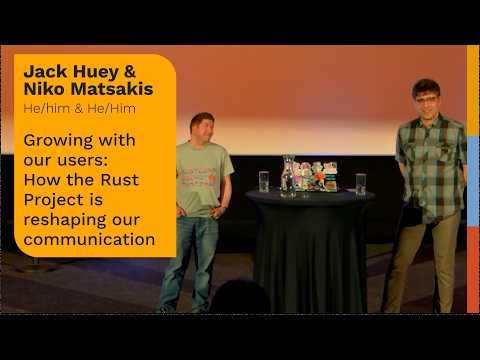
Growing with our users: How the Rust Project is reshaping our communication

RustNL
RustWeek 38:00 778 views

Growing with our users: How the Rust Project is reshaping our communication by Jack Huey and Niko Matsakis. Over the past fifteen years, Rust has grown from a small project used by Mozilla and few others, to being used by millions of developers. But our communication patterns haven't scaled well with that growth. In this talk, we'll present some of the initiatives that the Rust Project is undertaking, and participating in, in order to reshape the way we listen to and collaborate with our users. Structured efforts like the Vision Doc and User Research teams, the Project Goals process, and the Content Team, as well as ongoing collaborations such as with the Rust for Linux and Rust for CPython projects, each serve as tools to and lessons in how to communicate with and listen more effectively to our users. About Jack Huey (he/him): Jack Huey has been contributing to the Rust Project since 2019 and currently serves many roles, including co-leading the Types and Vision Doc teams, formerly acting as a leadership council representative, and currently acting as a Project Director. His passion in Rust is type system design and experimentation, but spends signficant time on Project health and governance. - git: https://github.com/jackh726 - linkedin: https://www.linkedin.com/in/jack-huey-phd/ About Niko Matsakis (he/him): Co-lead Rust vision doc & Language team, Sr. Principal Engineer at Amazon - git: https://github.com/nikomatsakis - bluesky: https://bsky.app/profile/nikomatsakis.com - linkedin: https://www.linkedin.com/in/nicholas-matsakis-615614/ - website: https://smallcultfollowing.com/babysteps/ This talk was given at RustWeek 2026 as part of the Main track on Tuesday 19 May. You can find a playlist of all talks in this track at https://www.youtube.com/playlist?list=PL8Q1w7Ff68DCvQXADosMcF0aMvLhGXU4S, and a playlist of all RustWeek 2026 talks at https://www.youtube.com/playlist?list=PL8Q1w7Ff68DBpmF38rcIAf8Z9Gj2TnlgM For information about RustWeek 2027, go to https://2027.rustweek.org. We hope to see you there!

Other talks by Nicholas Matsakis

Closing Keynote

TokioConf
43:07 703 views

Closing Keynote by Nicholas Matsakis Video Production by Confreaks Follow Confreaks 👇 https://confreaks.com https://confreaks.bsky.social https://x.com/confreaks

The currents of concurrency: reasoning with Async Rust

Rust Nation UK
RustNation 1:00:18 102914 views

Reasoning through concurrent systems has always been a challenging task. Poor code can be riddled with race conditions, non-terminating cases and other complex concurrency bugs; and even well-written code can be hard to understand. Async programming is an innovative concurrent programming model that rises to this challenge. In this talk, we'll explore reasoning with async Rust. We'll be introduced to its fundamental building blocks, such as `async`, `await`, `join` and `Pin`, and learn how to predict the behavior of code written with them. We'll build on these to simplify more complex concurrency puzzlers. Finally, we'll explore other models of concurrent programming to see how async Rust compares.

Let's get interdisciplinary: Rust Design Patterns for Chemical Plants

Rust Nation UK
RustNation 30:10 2853 views

With chemical plants as application example and engineers as our users in mind, we dig into safe API design with Rust. Therefore we build upon design patterns which are used for decades as catalog of solutions for recurring software architecture challenges. Beside the prominent builder and type-state pattern we will see how the visitor pattern allows us to define algorithms on an heterogeneous graph data structure such as used to represent a chemical process flowsheet.