We talk to people that are actively involved with building Rust about their work. What are the inner workings of the project? What's coming in the 2024 edition? Luca Palmieri will talk about those and other questions with our panelists.
🦀 *About Mara Bos* 🦀
Mara Bos (https://twitter.com/m_ou_se) has been a member of the Rust project since 2020, where she leads the Rust library team and is a member of the Rust leadership council. She wrote Rust Atomics and Locks and founded Fusion Engineering, a
Player unavailable or embedding blocked? Use the YouTube link above.
With the automotive industry shifting to software as the decisive factor for future vehicles, it is necessary to rethink how this software is developed. Any approach must ensure high quality and cost efficiency. However, most of today’s software in automotive is written in C and C++, which leads to excessive manual and tooling efforts to produce high-quality software.
PyO3 is used to build dual-language Rust and Python projects. After a brief introduction to the basics, in this tutorial we'll focus on building a Python module with Rust at its core. Along the way we'll learn about the advantages and disadvantages of mixing Rust and Python in this way.
Reasoning through concurrent systems has always been a challenging task. Poor code can be riddled with race conditions, non-terminating cases and other complex concurrency bugs; and even well-written code can be hard to understand. Async programming is an innovative concurrent programming model that rises to this challenge. In this talk, we'll explore reasoning with async Rust. We'll be introduced to its fundamental building blocks, such as `async`, `await`, `join` and `Pin`, and learn how to predict the behavior of code written with them. We'll build on these to simplify more complex concurrency puzzlers. Finally, we'll explore other models of concurrent programming to see how async Rust compares.
The SD Card specification is an interesting example of a protocol which runs over an SPI bus, and provides access to blocks on the disk. We’ll dig into the Embedded Devices Working Group’s “embedded-hal”, which allows us to write an SD Card driver that works with almost any microcontroller and see how we can use Rust types to represent the commands and responses we need to be able to talk to an SD Card and get it initialised. We’ll then look at the Microsoft FAT filesystem, and see how blocks on disk can represent the files and directories we’re familiar with. We’ll then run a few demos to see what we’ve learned in action.
Slides: https://github.com/rustnl/meetups/blob/main/20240507-delft/slides/Making%20Connections%20-%20Mara%20Bos.pdf
Follow Mara on:
twitter: https://twitter.com/m_ou_se
mastodon: https://hachyderm.io/@Mara
github: https://github.com/m-ou-se
This talk was given at RustNL 2024, in Delft, The Netherlands.
Playlist of other talks from RustNL 2024: https://www.youtube.com/playlist?list=PL8Q1w7Ff68DBZZbJt3ie5MUoJV5v2HeA7
Want to come to RustWeek 2025 in-person? go to https://2025.rustnl.org
A story about how things get stuck, and how to get things moving again. Taking improvements to the standard library's locks as an example, we'll take a look at how large efforts often get stuck, and explore what can be done in such situations. We'll look into breaking problems apart, how to narrow the scope of discussions, and finally at some organisational changes that might help a bit.
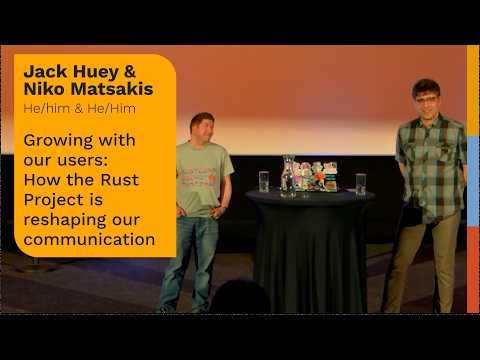
Growing with our users: How the Rust Project is reshaping our communication by Jack Huey and Niko Matsakis.
Over the past fifteen years, Rust has grown from a small project used by Mozilla and few others, to being used by millions of developers. But our communication patterns haven't scaled well with that growth. In this talk, we'll present some of the initiatives that the Rust Project is undertaking, and participating in, in order to reshape the way we listen to and collaborate with our users. Structured efforts like the Vision Doc and User Research teams, the Project Goals process, and the Content Team, as well as ongoing collaborations such as with the Rust for Linux and Rust for CPython projects, each serve as tools to and lessons in how to communicate with and listen more effectively to our users.
About Jack Huey (he/him):
Jack Huey has been contributing to the Rust Project since 2019 and currently serves many roles, including co-leading the Types and Vision Doc teams, formerly acting as a leadership council representative, and currently acting as a Project Director. His passion in Rust is type system design and experimentation, but spends signficant time on Project health and governance.
- git: https://github.com/jackh726
- linkedin: https://www.linkedin.com/in/jack-huey-phd/
About Niko Matsakis (he/him):
Co-lead Rust vision doc & Language team, Sr. Principal Engineer at Amazon
- git: https://github.com/nikomatsakis
- bluesky: https://bsky.app/profile/nikomatsakis.com
- linkedin: https://www.linkedin.com/in/nicholas-matsakis-615614/
- website: https://smallcultfollowing.com/babysteps/
This talk was given at RustWeek 2026 as part of the Main track on Tuesday 19 May.
You can find a playlist of all talks in this track at https://www.youtube.com/playlist?list=PL8Q1w7Ff68DCvQXADosMcF0aMvLhGXU4S, and a playlist of all RustWeek 2026 talks at https://www.youtube.com/playlist?list=PL8Q1w7Ff68DBpmF38rcIAf8Z9Gj2TnlgM
For information about RustWeek 2027, go to https://2027.rustweek.org. We hope to see you there!
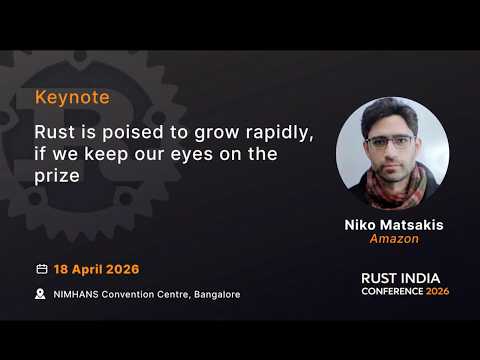
Keynote: Rust is poised to grow rapidly, if we keep our eyes on the prize
Speaker: Niko Matsakis — Co-lead, Rust Language Design Team | Senior Principal Engineer, Amazon
Niko Matsakis opens Rust India 2026 with a keynote on where Rust stands today and where it's headed.
Rust's reliability, efficiency, and productivity make it a natural fit for the hardest problems in systems engineering — large-scale networked applications, resource-constrained embedded development, and everywhere in between. Teams come to Rust for help with one problem, and end up wanting to use it everywhere. But growth brings its own risks.
In this keynote, Niko reflects on what has made Rust successful, what threats could slow that momentum, and what the community needs to keep its eyes on to stay on the right path.
Niko Matsakis is one of the original designers of the Rust language, co-leads the Rust Language Design Team, and has been shaping Rust's direction for over a decade.
🔗 Conference: https://rustindia.org
🦀 Join the Rust India community:
💬 Discord: https://discord.com/invite/p3uaTXS6NP
🐦 X/Twitter: https://x.com/IndiaRust
🦋 Bluesky: https://bsky.app/profile/rustindia.bsky.social
🔗 LinkedIn: https://www.linkedin.com/company/rust-india
📡 Matrix: https://matrix.to/#/#rustindia:matrix.org
📱 Telegram: https://t.me/RustIndia
#RustLang #RustKeynote #NikoMatsakis #SystemsProgramming #RustIndia2026
Niko Matsakis -- Over the last few months the Rust Vision Doc project group has been conducting interviews of folks using Rust, Rust project maintainers, and global Rust interest groups. Come and hear about the data we’ve gathered thus far and help us figure out the next steps in the process!
Follow Niko on:
twitter: https://twitter.com/nikomatsakis
github: https://github.com/nikomatsakis
This talk was given at RustNL 2024, in Delft, The Netherlands.
Playlist of other talks from RustNL 2024: https://www.youtube.com/playlist?list=PL8Q1w7Ff68DBZZbJt3ie5MUoJV5v2HeA7
Want to come to RustWeek 2025 in-person? go to https://2025.rustnl.org
 Rust Search